Powerhouse Architecture
Vetra is part of the Powerhouse Ecosystem and acts as the builder platform for creating an independent, open-source and decentralized back-end for any SaaS, ERP, CMS or CRM needs.
Local First. Built to Scale.
Vetra helps you build any type of web application on a Reactive Document Architecture. Define workflows once, deploy them globally, and co-own the software you create. The architecture is built on a minimal but powerful tech-stack: GraphQL, TypeScript, and React.
Reactive Document Architecture
The Powerhouse framework is built around structured document models and declarative design:
- Reactive: Real-time, responsive, and message-driven with an elastic scalable architecture.
- Document-Centric: Documents as local-first, self-contained data structures and nodes in a decentralized network.
- Git-like UX: State-of-the-art editing with history branching, merging, and commenting.
- Stateful: Documents with well-defined operations as state transitions become mini-APIs.
- Scalable: CQRS and EDA-inspired architecture with read models for data aggregation.
Specification Driven Design & Development
Complementing the Reactive Document Architecture, Powerhouse embraces Specification Driven Design & Development. This approach enables you to communicate your solution and intent through structured specification documents designed for AI collaboration. Specifications serve as a shared language—enabling precise, iterative edits that turn messy intent into clean execution. Our documents are machine-readable and executable, laying the groundwork for a "Git for Intent" for your AI agents.
Therefore, Vetra is the stack for sovereign infrastructure and AI-run, AI-mediated, AI-executed business, organizations, and networks.
Target Audiences
Vetra supports a variety of organizations with a headless open-source back-end:
- Decentralized Autonomous Organizations (DAOs)
- Scalable Network Organizations (an evolution of DAOs within the Powerhouse framework)
- NGOs and Governmental Organizations
- Cooperatives and distributed teams
Host Applications
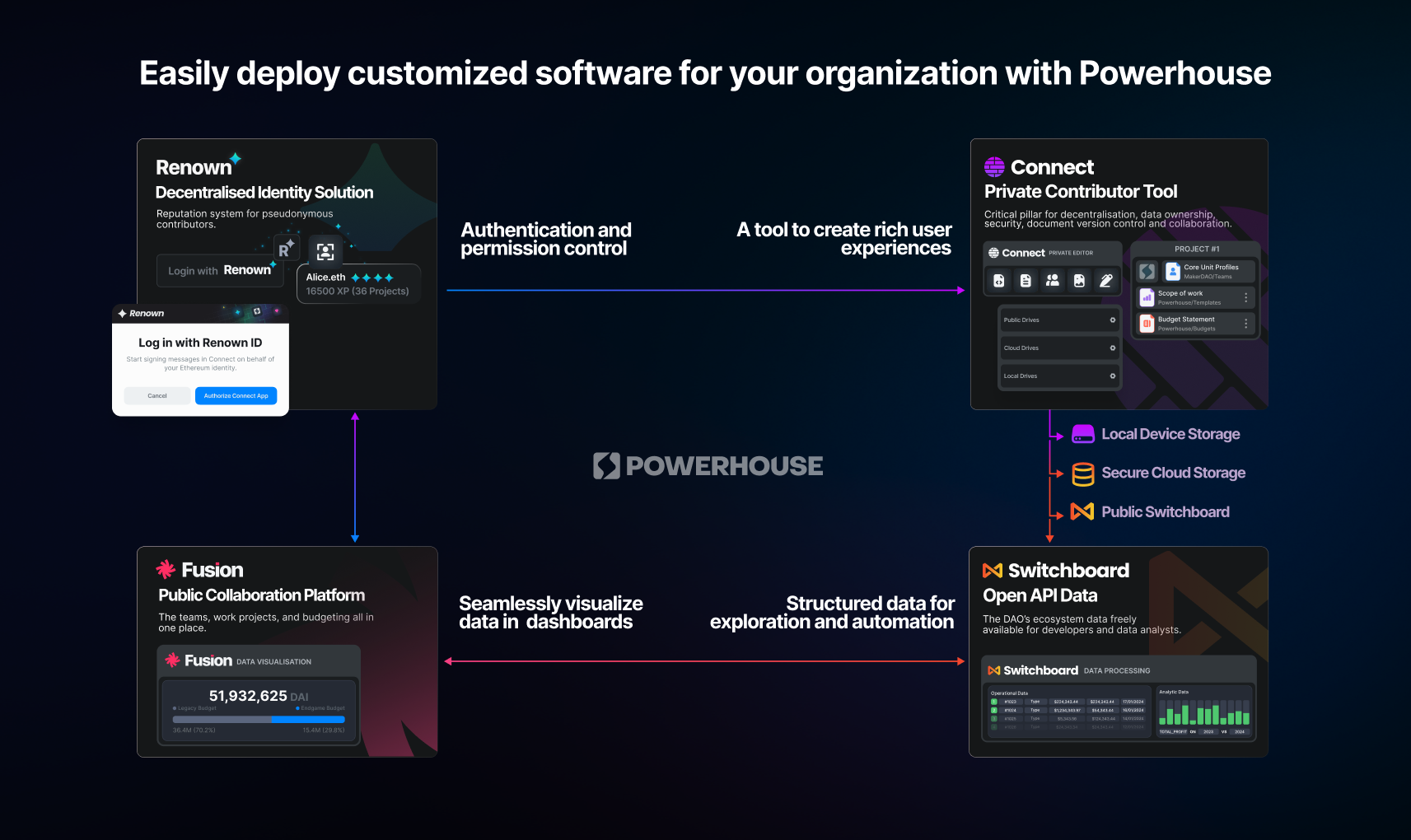
The Powerhouse ecosystem makes use of 4 core host applications that together form a modular, scalable operating system for any organization or business. Each application serves a distinct role, yet they are interdependent—working as a unified system to streamline operations, enhance collaboration, and drive automation.
- Connect – A collaboration hub and private workspace for independent contributors.
- Switchboard – The data infrastructure and API engine for managing remote instances.
- Fusion – An SDK for visualizing collected data and public-facing collaboration.
- Renown – A decentralized reputation and identity system.
How It All Connects: Reactors
The host applications sync their documents with one another through Reactors. A reactor is a node within any Powerhouse network responsible for storing documents, resolving conflicts, and verifying document event histories.
Reactors can be configured for:
- Local Storage – For offline or on-device access.
- Cloud Storage – For centralized, scalable data management.
- Decentralized Storage – Such as Ceramic or IPFS for distributed storage.
The documents within the network react to one another through the DocSync protocol—which sends updates from one reactor to another, ensuring all data stays synchronized across the system.
Powerhouse Platforms
With the help of these host applications, Powerhouse is launching 2 platforms that demonstrate the infrastructure that can be built with the Powerhouse tech-stack:
- Vetra Builder Platform: Sovereign infrastructure for scalable network organizations—local first, built to scale.
- Achra Decentralized Operations Platform: Where open organizations can procure and purchase services.